|
|
| (One intermediate revision by the same user not shown) |
| Line 50: |
Line 50: |
|
| |
|
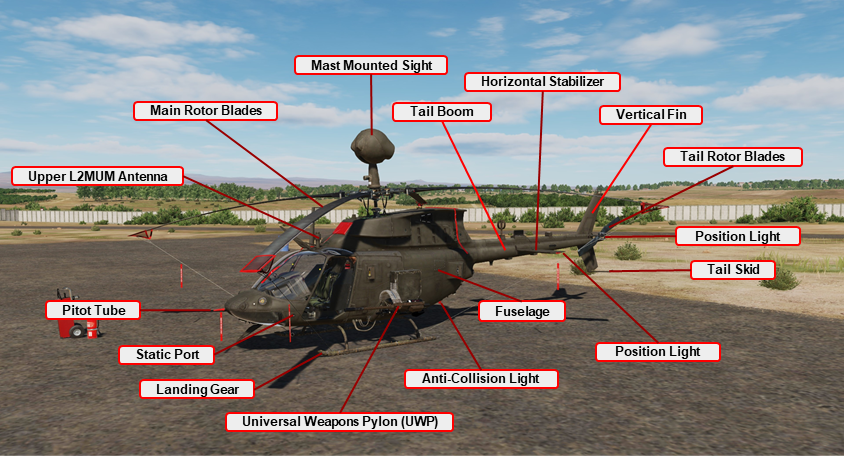
| [[file:external_overview2.png]] | | [[file:external_overview2.png]] |
|
| |
|
| |
| == Module Options ==
| |
|
| |
| The Options for the DCS OH-58D Kiowa Warrior can be found by accessing ‘Options’ from the Main Menu, then selecting ‘Special’ and navigating to ‘OH-58D(R)’ on the list of installed modules.
| |
|
| |
| [[file:module_options.png|800px]]
| |
|
| |
| === Control Display Location ===
| |
| The Control Display Location option selects the position at which the Controls Indicator is displayed on the screen
| |
|
| |
| === Cyclic Trim Type ===
| |
| There are four options for Cyclic Trim Type:
| |
| *None – pressing and releasing the Force Trim button has no effect on the cyclic
| |
| *Instant – pressing and releasing the Force Trim button instantly sets the center position of the joystick to the currently held cyclic position
| |
| *Fade In/Fade Out – pressing and releasing the Force Trim button moves the center position of the joystick to the currently held cyclic position over a fraction of a second
| |
| *Central Position Mode - pressing and releasing the Force Trim button instantly sets the center position of the joystick to the currently held cyclic position, but no joystick input is then registered until the joystick is centered
| |
|
| |
| === Pedal Trim Type ===
| |
| There are four options for Pedal Trim Type:
| |
| *None – pressing and releasing the Force Trim button has no effect on the pedals
| |
| *Instant – pressing and releasing the Force Trim button instantly sets the center position of the pedals to the currently held input position
| |
| *Fade In/Fade Out – pressing and releasing the Force Trim button moves the center position of the pedals to the currently held input position over a fraction of a second
| |
| *Central Position Mode - pressing and releasing the Force Trim button instantly sets the center position of the pedals to the currently held input position, but no further movement is then registered until the input is centered
| |
|
| |
| === Throttle Travel Range ===
| |
| The OH-58D Kiowa Warrior has a rotary throttle grip on the collective that governs fuel flow to the engine. In normal flight the fuel flow is controlled by the Full Authority Digital Engine Control (FADEC) and the throttle has no authority when above 68% when the FADEC switch is in the AUTO position.
| |
|
| |
| In the event that the FADEC fails or is disabled, fuel flow must be controlled using the throttle after placing the FADEC switch in the MAN position.
| |
|
| |
| The throttle axis has a stop that prevents travel below 50% (the IDLE position) to 0% (CLOSED position). Throttle at IDLE correlates to an engine speed of 63% to 65% Ng. A button on the Pilot Collective Grip must be depressed to allow for travel below the IDLE position.
| |
|
| |
| Since the lower range is not required outside of shutdown procedures, we have provided an option to dedicate the entire throttle axis to the upper half of the throttle range (IDLE to FULL) which allows much finer control of fuel flow and no risk of passing the IDLE stop when there is no hardware detent or stop.
| |
|
| |
| For most players, we advise using this option by selecting the ‘Full to Idle’ range.
| |
| Players who have the hardware capable to do so can allow the full range of throttle motion by selecting the ‘Full to Closed’ range.
| |
|
| |
| === ODA Eye Display ===
| |
| The Optical Display Assembly (ODA) is a helmet mounted display that attaches to the player’s night vision goggles. The ODA Eye Display option determines in which eye the ODA is displayed for VR users.
| |
|
| |
| === Cockpit Vibration ===
| |
| Adjusts the level of background vibration in the aircraft. Vibration due to effects such as ETL or overspeed are not affected.
| |
|
| |
| === FFB Force Strength ===
| |
| Allows adjustment of the strength of force exerted by a Force Feedback Stick.
| |
|
| |
|
| |
| == Additional Aircraft Properties ==
| |
|
| |
| There are a variety of options available in the DCS Mission Editor that allow a degree of customization of the DCS OH-58D Kiowa Warrior. Many of these options reflect real world changes to the airframe over its 33-year service history, allowing mission creators to modify the helicopter to represent a specific time period or mission capability.
| |
| These options can be found by placing an OH-58D(R) and selecting the ‘Aircraft Additional Properties’ tab.
| |
|
| |
| [[file:aircraft_additional_properties.png]]
| |
|
| |
| ==== Aircraft Control Priority ====
| |
| Determines which player has priority control of the aircraft in multicrew.
| |
|
| |
| ==== Remove Doors ====
| |
| Enable to remove doors from the aircraft. Doors can also be removed or added via the Ground Crew radio menu.
| |
|
| |
| ==== Install Pilot Display Unit ====
| |
| The Pilot Display Unit (PDU) is a roof mounted Heads Up Display system that was largely removed from aircraft due to safety issues with the night vision goggles used by pilots.
| |
|
| |
| For more information on the PDU, see Pilot Display Unit.
| |
|
| |
| ==== Equip Personal Weapons ====
| |
| Crew deployed in combat would often be equipped with personal weapons, primarily used for defense in case the aircraft needs to be evacuated in hostile territory. In the case of the Kiowa Warrior, these weapons were sometimes used offensively. In the DCS OH-58D Kiowa Warrior module we have included these weapons by default, and the Copilot may employ their weapon offensively.
| |
|
| |
| More information on how to employ this weapon can be found in Copilot’s Personal Weapon (M4).
| |
|
| |
| ==== Remove Mast Mounted Sight ====
| |
| The Mast Mounted Sight (MMS) is the large optical sensor mounted on top of the rotor mast. While the Kiowa Warrior almost always flew with the MMS attached, it could be removed for transportation and there are cases of the aircraft flying without the sensor attached both in deployment and in training.
| |
|
| |
| ==== Rapid Deployment Gear (MPLH) ====
| |
| Multi-Purpose Light Helicopter Rapid Deployment Gear was fitted to aircraft being transported as it allowed the aircraft to be lowered when stowed.
| |
|
| |
| ==== Install AN/ALQ-144 IRCM ====
| |
| The AN/ALQ-144 IRCM is a passive infrared countermeasures device that disrupts the seekers of missiles targeting the aircraft.
| |
|
| |
| The AN/ALQ-144 was replaced by the AN/AAR-57 Common Missile Warning System around 2009.
| |
|
| |
| More information on this system can be found in AN/ALQ-144 Infrared Countermeasures Device.
| |
|
| |
| ==== Import Editor Drawings ====
| |
| The OH-58D Kiowa Warrior navigation system allows for the creation of multiple flight routes, as well as the drawing of Battlefield Graphics that are used to display locations on the map.
| |
|
| |
| To facilitate the creation of these extra routes and graphics, we have implemented the ability to import Polygon and Line Drawings from the DCS Mission Editor as Routes and Graphics.
| |
|
| |
| By default, these drawings will be imported (subject to use of the correct naming convention). Disabling this option will prevent the drawings from being loaded into the OH-58D Kiowa Warrior’s mission computers.
| |
|
| |
| For more information on the use of Mission Editor Drawings to create Routes and Battlefield Graphics, see Creating Routes with Drawings and Creating Battlefield Graphics with Drawings.
| |
|
| |
| ==== IDM Net ====
| |
| The IDM Net value indicates which network the Improved Data Modem will connect to. The IDM will only be able to communicate with aircraft on the same network.
| |
|
| |

Aircraft History
The Bell OH-58 Kiowa is a remarkable piece of aviation history. This single-engine,
single-rotor military helicopter has served numerous roles, from observation and utility
to direct fire support.
The Bell OH-58 Kiowa was initially developed during the early 1960s as the D-250 for
the Light Observation Helicopter (LOH) program. Despite facing stiff competition from
rival Hughes OH-6 Cayuse, Bell refined its design and successfully submitted a variant
to the reopened LOH competition. The initial model, designated as the OH-58A, was
introduced in May 1969. Successive models followed, featuring uprated engines,
enhanced protection systems, and other improvements, culminating in the OH-58F.
In the 1970s, the US Army expressed interest in an advanced scout helicopter. The OH-
58 Kiowa was further developed, evaluated, and ultimately procured as the OH-58D
Kiowa Warrior. This variant was equipped to perform armed reconnaissance missions
and provide fire support to friendly ground forces. It featured a distinctive Mast
Mounted Sight (MMS) containing various sensors for target acquisition and laser
designation.
The OH-58D Kiowa Warrior introduced perhaps the most distinctive feature of the
Kiowa family, the Mast Mounted Sight (MMS). This gyro-stabilized platform contained
a television system, a thermal imaging system, and a laser range finder/designator.
These features gave the OH-58D the additional mission capability of target acquisition
and laser designation in day or night, limited-visibility, and adverse weather.
The Bell OH-58 Kiowa has a rich operational history, having been deployed in
numerous war zones over the decades. Only two months after its entry into service, it
was first deployed into the Vietnam War. The US Army made extensive use of various
OH-58 models, seeing active combat during the Gulf War, the Invasion of Panama, and
the War in Afghanistan among others.
Despite its proven capabilities, the OH-58 Kiowa was retired from active service in the
US Army in 2017. However, it continues to serve in several other countries’ armed
forces, including Greece, Taiwan, and Saudi Arabia. The Kiowa’s retirement was part of
a broader restructuring of the US Army’s aviation assets, which saw a shift towards the
use of unmanned aerial vehicles (UAVs) for reconnaissance roles.
The Bell OH-58 Kiowa is a testament to the ingenuity and adaptability of military
aviation design. From its early days as a light observation helicopter to its evolution
into a versatile combat platform, the Kiowa has proven its worth time and again. Its
legacy continues to influence the design of future military helicopters, ensuring that
the spirit of the Kiowa lives on.
External Overview